Paper - Modelling the effects of Credit Easing in the US using a DSGE approach
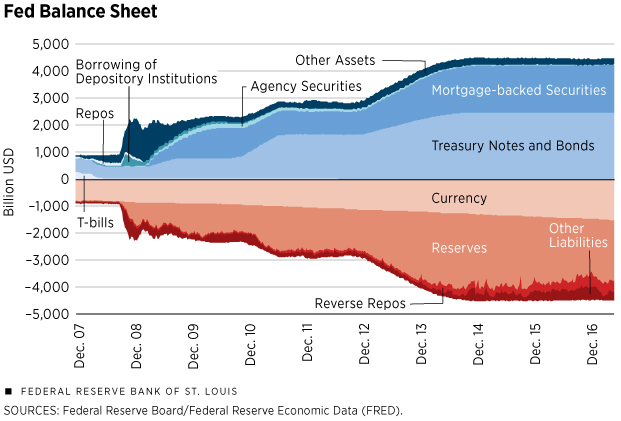 Image credit: St Louis Fed
Abstract
This paper develops a quantitative monetary DSGE model with financial intermediaries that face endogenously determined balance sheet constraints. From this, the framework is used to assess the extent in which unconventional monetary policy measures carried out by the Fed have been able to mitigate the disruptive effects which arise during a financial crisis. Within the model, unconventional monetary policy is interpreted as the expansion of central bank credit intermediation to offset a disruption of private financial intermediation. The results indicate that credit easing can be a highly beneficial policy response during a financial crisis, even in cases where the nominal interest rate has not reached the zero lower bound. However, in the event where the zero lower bound constraint is binding, the welfare benefits from this policy measure are enhanced substantially.